-

Hallie Ephron Reads From Night, Night, Sleep Tight
**Hallie Ephron** is the _New York Times_ bestselling author of 13 books, including her latest, _Night Night, Sleep Tight._ It was inspired by an infamous Hollywood murder that took place when she was growing up there in the ’60s, surrounded by the glamor of Tinsel Town. Come hear her speak about her latest work. The hairs on the back of your neck haven’t stood on end for a while.Partner:Boston Literary District -

Helping Endangered Species in Our Backyard
We may not have wild pandas and snow leopards, but New England is full of regionally endangered and threatened plants and animals. To maintain and restore the diversity of our natural heritage, we need to intelligently and actively help many of our rare wild neighbors. Come and learn about hands-on projects, in which Massachusetts school children and adults are helping us protect rare species, with a focus on our threatened freshwater turtles. (Photo: [Turtle Conservancy](https://en.wikipedia.org/wiki/Turtle_Conservancy "")) Visit [Grassroots Wildlife Conservation](http://www.grassrootswildlife.org/ "") to participate in protecting the state's endangered species in your own backyard.Partner:New England Aquarium -

When the Invasive Gets Tough…Make Beer?
_Fallopia japonica_, also known as Japanese knotweed, fleeceflower, Mexican bamboo, and other common names, is a highly successful, non-native perennial from eastern Asia. It can be seen along roadsides, riverbeds, and in empty lots in impenetrable stands up to 10 feet in height. It is indeed tough. But in the early spring, it is also tender…and edible. Pamela Thompson, Arnold Arboretum Manager of Adult Education, was joined by edible enthusiasts and brewers to share the history of this plant’s movement around the globe and the gustatory possibilities of this pernicious perennial, including beer. **What’s a Tree Mob™?** Tree Mobs are interactions with scientists or other specialists at the Arnold Arboretum, and provide another pathway to enjoy and learn in the landscape. Experts share little-known facts about our living plant collection, its relevance today, and its importance to future generations. A Tree Mob may attract a small group or a large gathering—we won’t know until it takes place. Join us in the landscape and discover something new.Partner:Arnold Arboretum -

Before Pedro Martinez Played Baseball
Before Pedro Martinez was the eight-time All-Star, three-time Cy Young Award winner, and World Series champion, before stadiums full of fans chanted his name, he was just a little kid from the Dominican Republic who sat under a mango tree and dreamed of playing pro baseball. On the eve of Pedro Martinez’s induction into the Baseball Hall of Fame, his co-author, Michael Silverman, will discuss his remarkable story.
Photo: Wikimedia CommonsPartner:Brookline Booksmith -
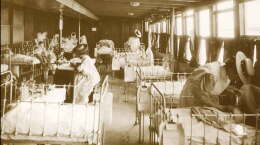
How a Harbor Barge Changed Pediatric Medicine
This is the remarkable story of Floating Hospital for Children, a Boston institution that became a pioneer in pediatric healthcare. The hospital began in 1894 as a ship commissioned to bring the city's poor, sick children out onto the harbor for fresh air and medical treatment. Throughout its impressive history, Floating Hospital made immeasurable contributions to the field of pediatrics (including the invention of infant formula) and eventually transitioned to its present-day brick-and-mortar building at Tufts Medical Center, which was designed like a ship in homage to the hospital's earliest days. Dan Bird, director of volunteers at Floating Hospital for Children and the driving force behind this new book from Union Park Press, will share highlights from this fascinating chapter in medical history.Partner:Revolutionary Spaces -

Cokie Roberts: Founding Mothers, Ladies of Liberty, and Capital Dames
With a lifetime of experience in Washington politics and a deep and abiding interest in the role women have played in American history, Cokie Roberts has a singular perspective on the importance of women in shaping our country. Roberts has explored this topic in two best-selling books, _Founding Mothers_ and _Ladies of Liberty_ and in her most recent work _Capital Dames: The Civil War and Women of Washington_ she commemorates the achievements and legacies of remarkable women during that wrenching period.Partner:Boston Public Library -

The Evolution Of Cooking: Studying Chimpanzee Cognition
Cooking is a universal human practice, and a complex behavior that involves multiple cognitive skills—such as patience, self-control, and causal reasoning. But the evolutionary origins of cooking are unclear. Examining chimpanzees' cognitive skills can illuminate the emergence of this uniquely human behavior. Harvard researchers Alexandra Rosati and Felix Warneken will present new insights from a recent set of studies in which they found that chimpanzees possess many of the necessary skills for cooking, suggesting that cooking behaviors emerged soon after the control of fire in human evolution.Partner:NOVA Science Café -
Boston Futures Group: Enhanced Transit and Mobility
In the Spring and Summer of 2015, as Boston shaped its bid to host the 2024 Olympic games, the MIT School of Architecture and Planning hosted a discussion addressing the city’s transportation future, upgrades to the Green and Red Lines, and conversations about transportation alternatives. Panelists discuss how Boston 2024’s efforts can continue the city’s path towards identifying and implementing new transport solutions for the future. **Boston Futures: 2024 and Beyond** Boston Futures is a community discussion series about the future of Boston and how Boston’s Olympic and Paralympic bid might help us achieve a shared vision for that future. Free and open to the public, these conversations will explore how hosting the Olympic and Paralympic Games in 2024 could help catalyze progress on key initiatives and ideas that will define Boston in the year 2030, the city’s 400th anniversary, and beyond. Boston Futures is co-organized by Boston 2024, Boston Society of Architects/AIA and the BSA Foundation, Boston Society of Landscape Architects, Harvard University Graduate School of Design, MIT School of Architecture and Planning, Northeastern University School of Architecture, ULI Boston, and The Venture Café. To learn more, visit the [Boston Futures: 2024 and Beyond](http://www.architects.org/programs-and-events/boston-futures-2024-and-beyond "") series page.Partner:Boston Society of Architects/AIA and the BSA Foundation -

Alysia Abbott Reads From Fairyland
**Alysia Abbott** learned from her father to boldly live the life you are meant to live. In her memoir _Fairyland_, she chronicles her unusual childhood, growing up on Haight St. in San Fransisco, raised by her father, a gay man who chose to pursue his life to the fullest, against all odds.Partner:Boston Literary District -

Frank Wilczek: A Beautiful Question
Nobel Prize winning researcher Frank Wilczek discusses his book, _A Beautiful Question: Finding Nature's Deep Design_. Wilczek answers a big question with his worK: Does the universe embody beautiful ideas? Artists as well as scientists throughout human history have pondered this “beautiful question.” From Plato and Pythagoras up to the present, Wilczek shows groundbreaking work in quantum physics that inspired by his intuition to look for a deeper order of beauty in nature. In fact, every major advance in his career came from this intuition: to assume that the universe embodies beautiful forms, forms whose hallmarks are symmetry—harmony, balance, proportion—and economy. There are other meanings of “beauty,” but this is the deep logic of the universe—and it is no accident that it is also at the heart of what we find aesthetically pleasing and inspiring. Chasing beauty through study was at the heart of scientific pursuit from Pythagoras, the ancient Greek who was the first to argue that “all things are number,” to Galileo, Newton, Maxwell, Einstein, and into the deep waters of twentieth century physics. Though the ancients weren’t right about everything, their ardent belief in the music of the spheres has proved true down to the quantum level. Indeed, Wilczek explores just how intertwined our ideas about beauty and art are with our scientific understanding of the cosmos. Wilczek brings us right to the edge of knowledge today, where the core insights of even the craziest quantum ideas apply principles we all understand. The equations for atoms and light are almost literally the same equations that govern musical instruments and sound; the subatomic particles that are responsible for most of our mass are determined by simple geometric symmetries. The universe itself, suggests Wilczek, seems to want to embody beautiful and elegant forms. Perhaps this force is the pure elegance of numbers, perhaps the work of a higher being, or somewhere between. Either way, we don’t depart from the infinite and infinitesimal after all; we’re profoundly connected to them, and we connect them. When we find that our sense of beauty is realized in the physical world, we are discovering something about the world, but also something about ourselves. Gorgeously illustrated, A Beautiful Question is a mind-shifting book that braids the age-old quest for beauty and the age-old quest for truth into a thrilling synthesis. It is a dazzling and important work from one of our best thinkers, whose humor and infectious sense of wonder animate every page. Yes: The world is a work of art, and its deepest truths are ones we already feel, as if they were somehow written in our souls.Partner:Harvard Book Store