-
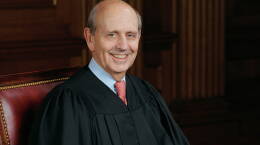
Justice Stephen Breyer: Judicial Issues Today
Supreme Court Justice Stephen Breyer engages in a discussion with NPR chief legal correspondent Nina Totenberg concerning the judicial issues facing the country today. Photo: By [Collection of the Supreme Court of the United States](http://www.supremecourthistory.org/02_history/subs_current/images_b/009.html, Public Domain, https://commons.wikimedia.org/w/index.php?curid=1423056 ""), Steve PettewayPartner:John F. Kennedy Library Foundation -
The Alcotts: The Real Family Behind "Little Women"
Jan Turnquist, executive director of Orchard House, discusses the daily activities and pursuits of the Alcotts, a trailblazing family of reformers.Partner:Revolutionary Spaces -
Human Services: Getting Your Money's Worth?
Join a panel of experts as they discuss the 2003 report *Reforming the Commonwealth's $2 Billion Purchase of Human Services: Meeting the Promise for Clients and Taxpayers*, which finds that while most clients still receive good care, they and their families frequently face long waiting lists, substantial barriers to access, and difficulty navigating the system, and many are not getting services matched to their particular needs. The Commonwealth's vast system for purchasing human services needs major reform, according to a report released on September 23, 2003 by the Massachusetts Taxpayers Foundation. This report, prepared by the Massachusetts Taxpayer Association in collaboration with the Massachusetts Council of Human Service Providers, and with major funding from The Boston Foundation, concludes that the burden of the system's flaws falls on the clients, who too often do not receive the quality services they need, and the taxpayers, who are not getting a fair return on the $2 billion spent annually on services purchased from private providers. Since its inception three decades ago, the purchasing system has grown rapidly to become the primary means of delivering human services, ranging from group homes for the developmentally disabled to treatment for juvenile offenders. Over 1,100 provider organizations care for 600,000 Massachusetts residents.Partner:Boston Foundation -
Meet the Poet: Adrienne Rich
Adrienne Rich reads from her and discusses her poetry. She is introduced by Lawrence Rosenwald, Anne Pierce Rogers Professor of English, Wellesley CollegePartner:Wellesley College -
Politics of Sexual Knowledge: The Carrigan Report
Professor James Smith of Boston College's English department discusses the beginnings of an "architecture of containment" in Ireland, constructed to silence those whose sexual behavior or family circumstances contradicted an emerging image of Irish Catholic identity. James O'Toole, history professor at Boston College, responds. This talk is the second in the series "Ireland Before the Republic: Culture and Politics 1922-1949." Smith is introduced by Robin Lydenberg, English professor at Boston College.Partner:Boston College -
Reawakening the American Soul
Called the "cradle of liberty," historic Faneuil Hall was the gathering place in the mid-1700s for the Sons of Liberty as they met to protest the arbitrary taxation policies of Great Britain. From these and subsequent meetings, protests were planned, including the Boston Tea Party, leading the way towards the ultimate liberation from British rule. Now, in our own time of crisis, with destructive forces taxing us once again, the bicentennial celebration of Emerson's birth calls for a new birth of freedom. It was Emerson's re-visioning of the founding principles of America, as voiced eloquently in his essays, lectures and poems, that sounded a clear, resonant and unifying note, tuning the disparate instruments and voices in his own time. This note has been heard by all the great American writers and poets down to the present. "Reawakening the American Soul" is led by three prominent writers and scholars with this vision. Their collective works represent a major contribution to defining and reassessing what one of them has called the "American Soul." They are Professors Richard Geldard, Jacob Needleman and Robert Thurman. Richard Geldard received his education at Bowdoin College, Middlebury College and his doctorate from Stanford University. He currently teaches at the Pacifica Graduate Institute in California and was Adjunct Professor of Philosophy at Yeshiva University in New York. He is author of numerous books, including *The Spiritual Teachings of Ralph Waldo Emerson*; *God in Concord*; *Remembering Heraclitus*; and the *Travelers' Key to Ancient Greece*. Long a student of the philosophy of Emerson, Dr. Geldard has made the challenging and inspirational work of the Seer of Concord accessible once again to a new generation of readers. His vision of Emerson allows us to take part in the spiritual quest for self-recovery in a time when immensesocial and intellectual forces are arrayed against us. Geldard has shown us that indeed the examined life as described by Socrates and Plato is not only possible for us but also absolutely necessary. Jacob Needleman is professor of philosophy at San Francisco State University and the author of many books, including *A Little Book on Love*, *Time and The Soul*, *The Heart of Philosophy*, *Lost Christianity* and *The American Soul*. In addition to his teaching and writing, he serves as a consultant in the fields of psychology, education, medical ethics, philanthropy and business and has been featured on Bill Moyers' acclaimed PBS series *A World of Ideas.* Robert Thurman was named as one of *Time* magazine's 25 Most Influential People of 1997. He holds the first endowed chair in Buddhist Studies in the West, the Jey Tsong Khapa Chair in Indo-Tibetan Buddhist Studies at Columbia University in New York. After education at Philips Exeter and Harvard, he studied Tibetan Buddhism for almost thirty years as a personal student of His Holiness the Dalai Lama. He has written both scholarly and popular books, and has lectured widely all over the world. His special interest is the exploration of the Indo-Tibetan philosophical and psychological traditions, with a view to their relevance to parallel currents of contemporary thought and science. One of his most recent books is entitled *Inner Revolution: Life, Liberty and the Pursuit of Real Happiness.* In a passage particularly relevant to the Faneuil Hall Forum, Thurman wrote: "To finish building the free society dreamed of by Washington, Franklin and Jefferson, we must draw upon the resources of the enlightened imagination, which can be systematically developed by the spiritual sciences of India and Tibet. We have not yet tamed our own demons of racism, nationalism, sexism and materialism. We have not yet made peace with a land we took by force and have only partly paid for. We are a teeming conglomeration of people from different tribes who have yet to embrace fully the humanness in one another. And none of us can be free until all of us are free."Partner:Philosophy Foundation -
Quincy Generations From Family to Faneuil Hall
John Quincy Jr., an 11th generation descendant of the Quincys in America and author of *Quincy's Market*, discusses the history of his well-known ancestors, one of New England's most famous political families. From the early 19th century's Edmund de Quincy to Mayor Josiah Quincy, the man responsible for building one of Boston's best known landmarks, Faneuil Hall Marketplace.Partner:Revolutionary Spaces -
Shut Out: Race and Baseball in Boston
Senior sports writer for *The Boston Herald*, Howard Bryant talks about his new book *Shut Out: A Story of Race and Baseball in Boston.* In his book, Bryant traces the haunting practice and legacy of racism, chronicling the policies and personality of the Yawkey family as well as the conflicted Boston press that wrestled with its own racial issues, set against the backdrop of Boston's difficult struggle with race.Partner:Revolutionary Spaces -
Emerson and the Examined Life
Robert Pinsky, award-winning author and poet, Richard Geldard and David M. Robinson, Emerson scholars, celebrate the bicentennial of Ralph Waldo Emerson with a live reading from famous American essays including Self-Reliance, The Oversoul and The American Scholar. Ralph Waldo Emerson was an essayist, orator, poet and philosopher whose vibrant words and original insights were meant to be heard by an engaged audience. The Pinsky reading will serve as living tribute to "the sage of Concord" in his 200th year. Robert Pinsky, poet laureate of the United States (1997-2000), is poetry editor of the online journal *Slate* and a contributor to *The Newshour with Jim Lehrer* on PBS. He teaches in the graduate writing program at Boston University. His book, *The Figured Wheel: New and Collected Poems* (1965-1995) was nominated for the Pulitzer Prize in poetry and also received the Lenore Marshall Award, the Ambassador Book Award of the English Speaking Union. His latest collection of poems is *Jersey Rain*; in November 1999 he published the anthology *Americans' Favorite Poems*, a collection of poems featured in Robert Pinsky's Favorite Poem Project, and in June 2002 published *Poems to Read: On Youth, Darkness, Passion and Other Subjects*. His book *Democracy, Culture and the Voice of the Public* was published in September 2002. For more information on upcoming Emerson events, please visit [Faneuil Hall Forum](http://www.faneuilhallforum.org ). **"Emerson's mind still provides the model of a central American intellectual and spiritual quest. Even his occasional shimmery vague patches, as much as his noble flights, embody something essential and familiar. We recognize much in our high art and low entertainment, in our politics and our manners, in his way of moving into and around a subject: the Emersonian sentences moving in a way that is fluid, heuristic, soaring and faltering, shifting in a sometimes casual way between oratory and introspection, an enterprise perpetually making itself up as it goes along. Uniquely, Emerson's genius successfully embodies itself as the poet and the lecturer in a single gesture, dreamy yet hortatory. At the juncture of inward meditation and passionate public speech, somehow both civic and idiosyncratic, Emerson calls us toward the best in our national character in an intrepid, candid, morally ambitious voice we can hope to recognize as our heritage." - Robert Pinsky**Partner:Philosophy Foundation -
Thomas Gainsborough: The Substance of Style
Frederick Ilchman discusses Thomas Gainsborough's elegant portraits, which were the height of fashion in 18th-century England. Ilchman discusses the context in which these works were created: Gainsborough's competitors and the demands of his patrons. By examining the artist's unique painting techniques, viewers discover the very substance of his singular style.Partner:Museum of Fine Arts, Boston