-
Best American Essays 2010
Series editor Robert Atwan joins contributors John Summers and Jerald Walker to discuss* The Best American Essays 2010*, the 25th anniversary volume.Partner:Harvard Book Store -

Electric Eye: Creating a Visual Prosthesis for the Blind
The complexities of the human visual system present a daunting challenge for those who work to restore sight to the blind. Dr. Shawn Kelly describes how the he and the Boston Retinal Implant Project team have met that challenge. The "electric eye" created by this team represents the leading edge of electrical engineering today, and it was listed on *Time Magazine's* 50 Best Inventions List of 2009. This implant gives us an indication of the very promising future of medical technology.Partner:Science for the Public -

Indian Ocean and the Shifting Center of Global Power
Robert D. Kaplan discusses the shifting center of global power and his new book, *Monsoon: The Indian Ocean and the Future of American Power.* In *Monsoon*, an examination of the Indian Ocean region and the countries known as "Monsoon Asia," Robert D. Kaplan shows how crucial this dynamic area has become to American power in the 21st century. Like the monsoon itself, a cyclical weather system that is both destructive and essential for growth and prosperity, the rise of these countries (including India, Pakistan, China, Indonesia, Burma, Oman, Sri Lanka, Bangladesh, and Tanzania) represents a shift in the global balance that cannot be ignored. *Monsoon* explores the multilayered world behind the headlines. Kaplan offers insights into the economic and naval strategies of China and India and how they will affect U.S. interests. He provides an on-the-ground perspective on the more volatile countries in the region, plagued by weak infrastructures and young populations tempted by extremism. This, in one of the most nuclearized areas of the world, is a dangerous mix.Partner:Harvard Book Store -
Ratification: The People Debate the Constitution, 1787-1788
MIT History Professor Pauline Maier discusses her book, *Ratification: The People Debate the Constitution, 1787-1788*, which tells the dramatic story of the two-year debate over the ratification of the Constitution, filled with chicanery and statesmanship, drawing on the speeches and letters of founding fathers on both sides of the debate--the first new account of this seminal moment in American history in decades. Pauline Maier has devoted over a decade to studying the immense documentation of the ratification of the Constitution. *Ratification* tells the dramatic story of the yearlong battle to ratify it. When the delegates left the Constitutional Convention in Philadelphia in September 1787, the new Constitution they had written was no more than a proposal. Elected conventions in at least nine of the 13 states would have to ratify it before it could take effect. There was reason to doubt whether that would happen. In both cities and small towns across the country people read the document carefully and debated it passionately.Partner:Massachusetts Historical Society -
Faculty Insight: Nuclear strategy in the Post-Cold War World
Faculty Insight is produced in partnership with Harvard University Extension School and ThoughtCast. This second interview of the series is with nuclear strategist Thomas Nichols, who is a professor at the US Naval War College in Rhode Island, a fellow at Harvard’s Kennedy School of Government and a lecturer at Harvard Extension School. He speaks with ThoughtCast’s Jenny Attiyeh about the conflict with North Korea, the potential for nuclear terrorism, and the reduction of nuclear stockpiles in the post-cold war world.Partner:ThoughtCast -

V.S. Naipaul: The Masque of Africa
V.S. Naipaul discusses his most recent work of travel writing as cultural history, *The Masque of Africa: Glimpses of African Belief*. V.S. Naipaul will be joined in conversation this evening by his editor, George Andreou. Like all of V. S. Naipaul’s travel books, *The Masque of Africa* encompasses a much larger narrative and purpose: to judge the effects of belief (in indigenous animisms, the foreign religions of Christianity and Islam, the cults of leaders and mythical history) upon the progress of civilization.Partner:Harvard Book Store -
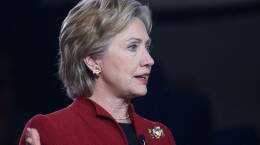
Hillary Rodham Clinton's "Living History" and the Genres of Authenticity
In the early 21st century, memoir culture, celebrity culture, and U.S. political culture have converged as Presidential wannabes publish memoir after memoir, thereby converting "a life" into money, message, and conduit for voter attachment. Hillary Clinton's best-selling autobiography *Living History* (2003) implicitly announced her Presidential bid, mobilizing personal storytelling to convince readers that this Senator and feminist First Lady could be President. Dr. Smith explores how the genres of Clinton's *Living History* produce, or not, the authenticity effect of a "real Hillary," the convincing persona that is always at stake in the political field; and how both the narrating and narrated "Hillarys" do and undo the gendered idioms of political power. Photo: Marc Nozell from Merrimack, New Hampshire, USA (Senator Clinton @ Hampton, NH) [CC BY 2.0 (http://creativecommons.org/licenses/by/2.0)], via Wikimedia CommonsPartner:Case Western Reserve University -
Steve Fitzpatrick: Wildfires, A Necessary Hazard
Steve Fitzpatrick: Wildfires, A Necessary Hazard. Steve explains wild fires to a class at Georgia Perimeter College. He talks about the causes, characteristics, the importance and the concerns regarding forest fires.Partner:Georgia Perimeter College -

Situational Awareness: Avoiding Distractions and Adapting to Change
Don Walker, former Delta Airlines pilot, talks about Situational Awareness to a class at Atlanta's Grady High School. Don explains why "texting while driving" will get you killed--sucking you in with what's known in the airline industry as "Target Fixation". He also talks about the importance of writing down your plans, and learning how to adapt those plans when necessary, so that you can achieve your goals.Partner:PBA -

A Call for Judgment: Sensible Finance
Amar Bhide takes apart the so-called advances in modern finance, showing how backward-looking, top-down models were used to mass-produce toxic products. He offers tough, simple rules: limit banks and all deposit taking institutions to basic lending and nothing else. Amar Bhidé is a visiting scholar at Harvard University's Kennedy School of Government and is the former Lawrence D. Glaubinger Professor of Business at Columbia University.Partner:Carnegie Council for Ethics in International Affairs