-

Christ Actually: Jesus in the 21st Century
**Hosted at the First Parish in Cambridge, 1446 Massachusetts Avenue** Award-winning author **James Carroll** discusses his new book, _Christ Actually: The Son of God for The Secular Age_ with Harvey Cox of Harvard Divinity School. Carroll asks what can we believe-and how can we believe in—Jesus in the post-20th century world of wars and Holocaust and the drift from religion that followed. Carroll revisits Christ’s crucial identity as a Jew. What can the ordinary humanness of the Christ figure mean to the 21st century? How can Christ, who is no Christian himself, transcend Christianity to speak to people in today’s world?Partner:Cambridge Forum -

The Bee: A Natural History
Bees pollinate more than 130 fruit, vegetable, and seed crops that we rely on to survive. Bees are crucial to the reproduction and diversity of flowering plants, and the economic contributions of these irreplaceable insects measure in the tens of billions of dollars each year. Yet bees are dying at an alarming rate, threatening food supplies and ecosystems around the world. In this natural history talk, **Noah Wilson-Rich** provides a window into the vitally important role that bees play in the life of our planet. He speaks about the human–bee relationship through time; explains a bit about bee evolution, ecology, and physiology; and shares his holistic approach to bee health and how you can help bee populations. (Image: [Coniferconifer](https://www.flickr.com/search?text=coniferconifer "Flickr")/Flickr)Partner:Arnold Arboretum -

Politics and the Pope
Boston Globe writers **James Carroll** and **Neil Swidey**, author **Mary Gordon**, and **Sister Simone Campbell**, organizer of “Nuns on the Bus,” discuss Pope Francis and what the shifts initiated by his papacy might mean for both domestic and world politics. **Margery Eagan**, columnist for The Boston Globe's Catholicism-news website, [Crux](http://www.cruxnow.com "CRUX"), and host of WGBH's midday news show [Boston Public Radio](http://wgbhnews.org/programs/boston-public-radio "Boston Public Radio"), moderates.Partner:John F. Kennedy Library Foundation -
Evolution of the Cosmos
Eric Chaisson is especially well known for his multidisciplinary approach to the evolution of the cosmos: from sub-atomic particles at the very beginning, to the emergence of galaxies (still difficult to explain), to stars, planets, and life. Each stage represents greater complexity, yet there is an underlying order. Dr. Chaisson is the author of the most widely used astronomy textbook, plus several books for the general reader. His lecture series at the Museum of Science some years back was also very popular.Partner:GBH Forum Network -

Anita Diamant: Boston Girl
From **Anita Diamant**, New York Times bestselling author of _The Red Tent_ and _Day After Night_, comes an unforgettable novel about family ties and values, friendship and feminism told through the eyes of a young Jewish woman growing up in Boston in the early twentieth century. Written with the same attention to historical detail, _The Boston Girl_ is a moving portrait of one woman’s complicated life in twentieth century America, and a fascinating look at a generation of women finding their places in a changing world.Partner:Brookline Booksmith -

Arthur Shurcliff: From Boston to Colonial Williamsburg
In 1928, the landscape architect and preservationist Arthur A. Shurcliff (1870–1957) began what became one of the most important examples of the American Colonial Revival landscape—Colonial Williamsburg. But before this, Shurcliff honed his skills in Boston. An 1894 engineering graduate of MIT with an interest in landscape design, Shurcliff, on the advice of Frederick Law Olmsted and with the aid of his mentor, Charles Eliot, pieced together courses at Harvard College, the Lawrence Scientific School, and the Bussey Institute. He then spent eight years working in the Olmsted office, acquiring a broad and sophisticated knowledge of the profession. Opening his own practice in 1904, Shurcliff emphasized his expertise in town planning, preparing plans for towns surrounding Boston. He designed recreational spaces that Bostonians still enjoy today, including significant aspects of the Franklin Park Zoo and the Charles River Esplanade.Partner:Arnold Arboretum -
Exoplanet Atmospheres
Dr. Lopez-Morales explains how she and her colleagues detect and then analyze exoplanet atmospheres, a very exciting part of the exoplanet frontier. She is involved in several large international projects, and she what the exo-atmospheric signatures reveal up to now.Partner:GBH Forum Network -
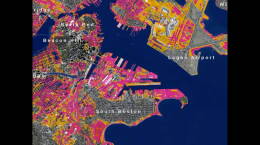
The City and the Sea: Boston’s Evolving Dance With Water
Architects, designers, politicians, city planners, advocates, students and Boston-area citizens convened at the **Boston Society of Architects/AIA** space on Congress Street to discuss how the city and state will cope with inevitable sea level rise and future flood events. Learn about the history of Boston's sea walls, the natural barriers that protect Boston Harbor and see some futuristic plans for how to manage living in a part of town that could someday flood during high tide. **Boston City Council member Mike Ross** emceed the event, designed to explore Boston’s evolving relationship with the ocean—both in how we built up the shorelines over the past three centuries and what that means as we face present-day sea-level rise. Issues addressed include which low-lying areas we need to start thinking about now, what we can learn from neighborhoods such as the Back Bay that were created from historic wetlands, and when designing new sites, what must be considered.Partner:Boston Society of Architects/AIA and the BSA Foundation -
Moving Forward on Climate Change and Sustainability
Sierra Club's **Mary Anne Hitt**, Tufts ecologist **Julian Agyeman**, NASA's **Gavin Schmidt** and policy advisor **Nigel Purvis** convened at the WGBH Idea Lab in 2014, to discuss efforts to stop deforestation, climate modeling, a grassroots effort to reduce or clean up coal-fired power plants, and a presentation on building greener and more equitable cities. The Innovation IdeaLab is an invitation-only, day-long gathering that brings together powerful thought leaders and doers for the purpose of inspiring new public media stories on topics ranging from climate change, food and health, and creativity and entrepreneurship, to building more equitable societies. on efforts to stop deforestation, climate modeling, a grassroots effort to reduce or clean up coal-fired power plants, and a presentation on building greener and more equitable cities.Partner:WGBH -
Building Greener, More Equitable Businesses & Societies
Learn how businesses can move toward greater sustainability, worker-owned cooperative businesses, and efforts to create better conditions for the workers who take care of the nation's seniors.Partner:WGBH