-
Shah Selbe: Using Technology to Save the World
Earth is currently in the midst of the sixth mass extinction, where poaching, overfishing, and habitat destruction are driving wildlife populations to critically low levels. Conservation needs better methods to help mitigate the effects of climate change and human impact. Thankfully, we are living in age where technology has improved nearly everything we deal with on a daily basis. **Shah Selbe** has, through his work as a National Geographic Explorer, developed innovative conservation technologies to deal with protecting wildlife and protected areas globally. This work has taken him from the beaches of Palau, wetlands of Botswana, mangroves on Caribbean islands. Hear Selbe tell stories of using drones, satellites, and the Internet of Earth Things (focused on connecting ecosystems using the same technology as “smart homes”) to help stop wildlife crime and ensure a future full of iconic animals like elephants, bluefin tuna, and tigers.Partner:New England Aquarium -

The Future of Food, An Urban Answer?
Climate change has forced us to rethink our options about many things, including how and where we grow our food. **James Miner**, Principal of urban design and planning at Sasaki Associates in Watertown, has focused much of his practice on creating more sustainable communities for future generations. **Jessie Banhazl**, founder and CEO of Green City Growers, helps to change people's perception of what is possible through her own rooftop farming revolution, growing fresh food in the most unlikely places. Miner, who lectures and writes extensively on how local food can be used to promote economic development, and Banhazl, who uses her work to prove that sustainable agriculture can be both healthy and profitable, discuss their opinions on the future of agriculture in an age where finding sustainable solutions for growing healthy food is paramount.Partner:Cambridge Forum -
Making a Global Plan for Climate Change
Dr. Henrik Selin explains the urgent need for a serious international commitment to deal with climate change and its impact on all nations. He assesses the recent Paris agreement and he explains why public engagement and pressure will be essential to establishing a viable climate policy.Partner:Science for the Public -

Urban Identity Quest: A Conversation with the Mayor Karl Dean of Nashville
During Mayor **Karl Dean**'s tenure, the City of Nashville experienced an extraordinary construction boom, as it worked to expand public transit, connect neighborhoods, and strengthen the city's brand. What can the Boston region learn from Nashville's efforts? Can cities outgrow their identities, and how do architects and city planners work together to develop new brands? **Geeta Pradhan**, President of the Cambridge Community Foundation, addresses these questions with Nashville's former Mayor Dean, the first Mayor in Residence at the Boston University Initiative on Cities. Their conversation touches on issues of equity, access, and exploring the relationship between civic goals and the physical city.Partner:Boston Society of Architects/AIA and the BSA Foundation -

Picturing Frederick Douglass: The Most Photographed American of the 19th Century
Newly discovered photographs of Frederick Douglass reveal that he – not Lincoln, Whitman, or General Custer, as previously claimed – was the most photographed American of the 19th century. Douglass understood the promise of his country’s new fascination with the camera and believed that photography could be a catalyst for reform. He used these widely circulated portraits to create a black public persona, counter racist iconography, and promote equality. University of Nottingham Professor Zoe Trodd traces Douglass’s visual journey from fugitive slave to elder statesman, and outlines the legacy of these 160+ photographs.Partner:Revolutionary Spaces -

Steam Punk History: Low-Tech Storytelling in the Digital Age
Uncovering history is one thing; presenting it effectively is another. Even in the digital age, there are "low tech" methods that can be used to aid greater public understanding of important people, places and events. The **[Shoeleather History Project](https://shoeleatherhistoryproject.com/ "")** uses "clothesline" presentations, ViewMaster, trading cards, participatory walking tours, comics and other forms to teach "history from below."Partner:History Camp Boston -

Busing in Boston: Teaching the History of Segregation, Desegregation, and Busing
The Boston busing crisis and public school desegregation of 1974 to 1988 was an extremely contentious period in local history that reverberated nationally. To help students and others understand what happened and why, the Boston Public Schools have created online resources for teaching about the history of segregation, desegregation, and busing in Boston. **Josue D. Sakata**, Assistant Director for History and Social Studies for Boston Public Schools, reviews that history and discusses how it is presented in the Boston Public Schools today, including how the online resource was created and how it is used with students. (Image: Herbert E. Glasier [Public domain], via [Wikimedia Commons](https://commons.wikimedia.org/wiki/File:South_Boston_High_School_-_0403002157a_-_City_of_Boston_Archives.jpg "South Boston High School"), image cropped)Partner:History Camp Boston -
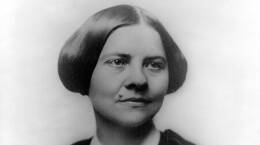
I Now Pronounce You: Lucy Stone
Meet Lucy Stone, the first woman from Massachusetts to earn a college degree and a lifelong supporter of human rights. As a scholar, Stone studied Greek and Hebrew and argued that the Holy Bible was mistranslated to oppress and objectify women. In her personal life, she demanded that her marriage vows be rewritten and refused to take her husband’s surname, leading to the moniker "Lucy Stoner" for a woman who does just that. As a public speaker, Stone campaigned for equal rights for women and African-Americans, and inspired many women, including Susan B. Anthony, to join the suffrage movement. Critically acclaimed actress **Judith Kalaora** portrays this outspoken 19th-century "feminist-abolitionist" in this performance, written by the actress herself. (Image: [Public domain], via [Wikimedia Commons](https://commons.wikimedia.org/wiki/File:Lucy_stone.jpg "LucyStone"), image cropped)Partner:Revolutionary Spaces -

"Sick and Tired of Being Sick and Tired": Celebrating Freedom Heroes
Despite fierce prejudice and abuse, Fannie Lou Hamer was a champion of civil rights from the 1950s until her passing in 1977. Integral to Freedom Summer 1964, Hamer's speeches spurred the nation to support equal and voting rights causes. Author Carole Boston Weatherford and illustrator Ekua Holmes discuss their 2015 book, Voice of Freedom: Fannie Lou Hamer, which honors Hamer's life and legacy with a message of hope, strength and determination. The Museum of African American History's Director of Education and Interpretation, L'Merchie Frazier, introduces the conversation about Hamer as well as other freedom heroes featured in And Still We Rise: Race, Culture, and Visual Conversations, an exhibit companion book ranging from pioneering poet Phillis Wheatley to famed abolitionist Frederick Douglass to the distinguished Tuskegee Airmen. Frazier is also the visual and performing artist who wrote the Foreword to And Still We Rise, the first visual history published to utilize African American quilting to chronicle the black experience in America from 1619 to 2013.
Image: Warren K. Leffler; restored by Adam Cuerden [Public domain], via [Wikimedia Commons (https://commons.wikimedia.org/wiki/File:Fannie_Lou_Hamer_1964-08-22.jpg "Fannie Lou Hamer"), image cropped)Partner:Museum of African American History -

Marie Howe: Poetry Reading
Former New York poet laureate **Marie Howe** reads from her poetry collections and speaks about the role of spirituality and imagination in her work. An acclaimed poet, Howe is the author of three poetry collections: _The Good Thief_ (1988), _What the Living Do_ (1997), and _The Kingdom of Ordinary Time_ (2008). Howe's work deals with themes of faith, loss, and family: the secular and the sacred, childhood and living. She grew up in a Catholic family, the eldest of nine children, and has said that the nuns who provided her education also shaped her theology: "I began to appreciate that spirituality could be rigorous. It could be imaginative." In _What the Living Do_, she faces the death of her brother from AIDS and writes about his loss with what the Boston Globe has described as "a poetry of intimacy, witness, honesty, and relation." (Photo: Metropolitan Transportation Authority of New York (Poetry in Motion: The Poet is In) [[CC by 2.0](http://creativecommons.org/licenses/by/2.0 "CC")], via [Wikimedia Commons](https://commons.wikimedia.org/wiki/File:Poetry_in_Motion-_The_Poet_is_In_(17060822750).jpg "Marie Howe poet is in"), image cropped)Partner:Boston University