-

The Manifesto Against Parenting
In the past thirty years, the concept of parenting and the multibillion-dollar industry surrounding it have transformed child care into obsessive, controlling, goal-oriented labor intended to create a particular kind of child and thereby a particular kind of adult. In _The Gardener and the Carpenter_, developmental psychologist and philosopher Alison Gopnik argues that the familiar twenty-first-century picture of parents and children is profoundly wrong - it's not just based on bad science, it's also bad for kids and parents. Photo: [Pixbay](https://pixabay.com/en/family-together-parenting-lifestyle-492891/ "")Partner:Cambridge Forum -

BostonTalks Investigates: Health Care for Refugee Women
At the end of 2015, a staggering number of people around the world—one out of every 113 people, to be exact—were estimated to be forcibly displaced from their homes. Half of these people, labeled asylum-seekers, internally displaced persons or refugees, are women, according to the United Nations. Join WGBH’s Beat the Press TV host, Emily Rooney (@EmilyRooneyWGBH) and experienced Doctors Without Borders/Médecins Sans Frontières (MSF) aid workers for a discussion about the unique and pressing health challenges facing displaced women. Learn how Doctors Without Borders provides family planning, obstetric care, and medical treatment for sexual violence to patients on the move or living in refugee camps—and how Doctors Without Borders offers mental health care, a crucial component of treatment for survivors of violence. This talk is part of a **Doctors Without Borders** interactive outdoor exhibition, [Forced From Home](http://www.forcedfromhome.com/ ""), which came to Boston’s Long Wharf in October 2016.Partner:WGBH -

Peace Through Entrepreneurship: Investing in a Startup Culture
In his book _Peace Through Entrepreneurship_ Steven R. Koltai argues that joblessness – not religious or cultural conflict – is the root cause of the unrest, extremism, and terror that vexes American foreign policy and threatens American security. He offers a new solution based on a quintessentially American value and underutilized foreign policy tool: entrepreneurship. As the first Senior Advisor for Entrepreneurship under Secretary Hillary Clinton at the State Department, Koltai not only sets forth why this is good policy, but how the US Government can do it better. Photo: ["The Incubators Youth Outreach Network"](https://commons.wikimedia.org/w/index.php?curid=32105923 "") By Abelkazzah - Own work, CC BY-SA 3.0,Partner:WorldBoston -

History of the U.S. Lightship Service, 1820–1985
Part of the Series Beacons of Beantown: 300 Years of Boston Lights, Co-Presented by Old South Meeting House and Friends of the Boston Harbor Islands From 1820 to 1985, the U.S. government built 179 lightships, ships that functioned as “floating lighthouses,” in coastal waters and on the Great Lakes –where environmental hazards and conditions made construction of a lighthouse impractical. These ships housed bright and powerful navigational light beacons atop their masts to guide maritime traffic into their ports of call. The largest lightship ever built in the U.S. was the Nantucket Lightship/LV-112; as the first landmark seen by transatlantic ships entering American waters from Europe, she earned the nickname “Statue of Liberty of the Sea.” Built in 1936, Nantucket Lightship/LV-112 today is berthed in her homeport of Boston, and open to the public while undergoing restoration. Robert Mannino, Jr., president of the U.S. Lightship Museum, will share the fascinating story of this National Historic Landmark and National Treasure, placing it in the colorful history of the U.S. Lightship Service as a whole.Partner:Revolutionary Spaces -
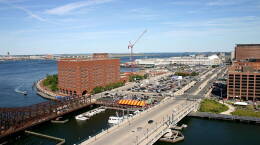
Boston's Seaport and Moakley Courthouse at 25
The John J. Moakley federal courthouse celebrated the 25th anniversary of its site selection on Boston’s Fan Pier with a special film screening and exhibition by architectural photographer Peter Vanderwarker. A panel discussion about the development of the South Boston Seaport district featuring Bill Rawn FAIA, Jean Carroon FAIA, Former BRA chief planner Kairos Shen, and Renée Loth, editor of Architecture Boston, follows the short film. Photo: Danielle Walquist Lynch from Boston (Another view of the Channel) [CC BY 2.0 (http://creativecommons.org/licenses/by/2.0)], via Wikimedia CommonsPartner:Boston Society of Architects/AIA and the BSA Foundation -

Discussion of The Race Underground
In the late nineteenth century, as America’s largest cities grew dangerously congested, the time had come to replace the nostalgic horse-pulled carriages clogging the streets with a faster, cleaner, safer form of transportation. Ultimately, it was Boston—a city of so many firsts—that overcame a litany of engineering challenges, the selfish interests of businessmen, and the great fears of its citizenry to construct America’s first subway. THE RACE UNDERGROUND tells the dramatic story of an invention that changed the lives of millions. Co-Presented with First Look, WGBH’s premier showings of its highly acclaimed new films. Image source: American ExperiencePartner:WGBH -

Transforming Oil Rigs in to Thriving Ocean Reefs
There comes a time when the useful life of an oil platform comes to an end, at least when it comes to drilling for oil, and that’s when Emily Callahan and Amber Jackson, co-founders of Blue Latitudes, dive in. They are marine scientists on a mission to re-purpose offshore oil and gas platforms as artificial reefs around the world. The oil platforms found in their home state of California, like most offshore oil platforms around the world, are home to some of the most productive ecosystems on the planet. As the world’s natural reefs are overfished, over-trawled and polluted, Amber and Emily believe that re-purposing these structures, some the size of the empire state building, as artificial reefs, may be the best decision for the future of our oceans. It’s time to think creatively about the resources we have, and proceed forward boldly with radical new tactics for ocean management. Callahan and Jackson explain how[ Rig2Reef Exploration](https://www.facebook.com/rig2reefexploration/ "rigs to reefs") has successfully conducted research expeditions in the North Sea, Gulf of Mexico and California, investigating the ecological, economic and cultural benefits of re-purposing these offshore platforms in a variety of ways, from eco-tourism hot spots, to national marine sanctuaries.Partner:New England Aquarium -

BostonTalks: Here’s to You, Boston
This time we spotlight The Hub._ The Curiosity Desk's_ **Edgar Herwick** asks, "Just what is it that makes Boston, Boston?" The Sox and the Citgo sign? The hallowed and oft-maligned T? Our Puritan past? All those thinkers, geeks, and entrepreneurs buzzing about? How do Bostonians define their city and just how accurate is the image of it that we broadcast to the rest of the world? _Boston Globe_ reporter [**Alex Beam**](https://twitter.com/imalexbeamyrnot "Alex on Twitter") brings his signature wry wit to the party for an incisive look at the region, and historian [**Ed O'Donnell**](https://twitter.com/InThePastLane "Ed on Twitter") examines some of the local history that tends to get swept under the rug. Plus, [**John Romard**](https://twitter.com/BostonAttitude "John on Twitter") offers his spirited take on the soul of the city. And if that isn't enough, Lesley University's Dean of the College of Art and Design, [**Richard Zauft**](https://twitter.com/RichardZauft "Richard on Twitter") gives insight into the trajectory of creativity. (Image By By Matthias Rosenkranz CC BY-SA 2.0 http://creativecommons.org/licenses/by-sa/2.0, via Wikimedia Commons)Partner:WGBH -
Breakthroughs in Nanotechnology
The Sonkusale Nanolab at Tufts University is currently engaged in cutting-edge research in several interdisciplinary areas, including nano-devices that benefit medicine and the life sciences. A major interest is the development of flexible, embedded sensors for diagnostics. **Dr. Sameer Sonkusale** and his team also work on zero-cost "do-it-yourself" diagnostics for the developing world.Partner:Science for the Public -

From Hills to Islands: Ancient Adaptations to the Inundation of Boston
From Hills to Islands: Ancient Adaptations to the Inundation of Boston. Some 6,000 years ago, Boston was well inland from the ocean, but as rising sea levels poured in tidal waters around the hills east of Boston, ancient Native Americans lost no time adapting to and enjoying the change. Spectacle Island preserved a wonderful record of several thousand years of clam bakes, fishing and other activities, excavated as part of the Big Dig project. While Martin Dudek, Senior Project Manager of Commonwealth Heritage Group, will focus on Native American sites on Spectacle Island, he will also include a brief overview of other exciting archaeological sites worked on for the Big Dig.Partner:Paul Revere Memorial Association