-

Atmosphere: Earth and Elsewhere
In this mini-documentary, Dr. Daniel Cziczo explains what atmosphere is, what it does, how it changes, why it needs our care on Earth. He also explains terraforming, geoengineering, and the search for atmospheres on certain moons and even exoplanets.Partner:Science for the Public -

Communicating Climate Change through Science and Technology
Dr. Brian Helmuth discusses how climate change is experienced by different species on a very local level. Organisms such as mussels and fish in the same environment can be impacted by local ocean temperature and acidity very differently. Understanding these differences in this time of rapid climate changes can help us understand the variability of different species to adapt –or not. Dr. Helmuth also describes some of the innovative and international projects from his lab that engage young people in addressing the climate change challenge.Partner:Science for the Public -
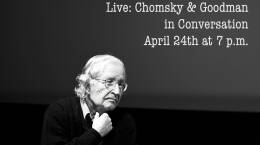
Noam Chomsky and Amy Goodman Discuss Economic Inequality
**Noam Chomsky**, MIT's Professor of Linguistics and Philosophy, and **Amy Goodman**, host of the award-winning independent news program _Democracy Now!_ discuss the unprecedented rate of inequality in the U.S. and its impacts on society and democracy, as addressed in Chomsky's book/doc film, [_Requiem for the American Dream: The 10 Principles of Concentration of Wealth & Power_](http://www.harvard.com/event/noam_chomsky/ ""). Noam Chomsky is widely regarded as the most influential thinker of our time, but never before has he devoted a major book to one topic: income inequality. "Requiem for the American Dream" is not an essay collection but an entire work of some 70,000 words based on four years of interviews with Chomsky by the editors. Chomsky considers these to be his final, long-form documentary interviews. It is a book that makes Chomsky's breadth and depth accessible, and at the same gives us his most powerful political ideas with unprecedented, breathtaking directness. It will go down as one of his greatest and most lasting contributions. Requiem for the American Dream is being produced in tandem with the film of the same name that was recently released in selected theaters and is now available to watch via online streaming.Partner:Harvard Book Store -

The French Elections
The first round of the 2017 French presidential election – the most unpredictable in decades — will take place on April 23. The unpopular incumbent, Francois Hollande, did not seek a second term, leaving five candidates chasing a place in the second-round runoff on May 7. With Hollande’s would-be Socialist successor Benoît Hamon on the margins, and main opposition Republican nominee Francois Fillon dogged by scandal, the race is wide open for the young maverick Emmanuel Macron – and for the National Front’s Marine Le Pen. Will France follow recent British and American election results down a populist, anti-immigrant path? This talk, to be held 48 hours after the first round returns, explores the issues and the stakes facing French voters in April, May and June, when parliamentary elections will decide who governs France for the next five years and whether the Fifth Republic is strong enough to withstand the combined challenges of populism and weakened parties.Partner:Case Western Reserve University -

Boston Public Library Literary Lights 2017
The Associates of the Boston Public Library recognize authors Kwame Anthony Appiah, Susan Faludi, Jane Kaminsky and Wally Lamb at the 2017 Literary Lights Awards. Each year the Literary Lights event honors distinguished authors from the Northeast for their contributions to literature and the written word. ###### Literary Lights of 2017 and Their Presenters **Kwame Anthony Appiah** New York Times columnist, “The Ethicist,” and author of The Honor Code: How Moral Revolutions Happen Presented by Henry Louis Gates, Jr. **Susan Faludi** Pulitzer Prize–winning journalist and author of Backlash: The Undeclared War against American Women Presented by Christopher Lydon **Jane Kamensky** Harvard University professor and author of A Revolution in Color: The World of John Singleton Copley Presented by Jill Lepore **Wally Lamb** Novelist and author of I’ll Take You There and I Know This Much Is True Presented by Andre Dubus III Keynote speaker:** The Honorable Margaret H. Marshall** First female Chief Justice of the Massachusetts Supreme Judicial Court Presented by **David Leonard**, President, Boston Public LibraryPartner:Boston Public Library -

Susanna Siegel: The Rationality of Perception
Professor of Philosophy Susanna Siegel, prize-winning author of _The Contents of Visual Experience_, leads a discussion of her new book, _The Rationality of Perception_. PUBLISHER'S DESCRIPTION On a traditional conception of the human mind, reasoning can be rational or irrational, but perception cannot. Perception is simply a source of new information, and cannot be assessed for rationality. Susanna Siegel argues that this conception is wrong. Drawing on examples involving racism, emotion, self-defense law, and scientific theories, The Rationality of Perception makes the case that perception itself can be rational or irrational. The Rationality of Perception argues that reasoning and perception are often deeply intertwined. When unjustified beliefs, fears, desires, or prejudices influence what we perceive, we face a philosophical problem: is it reasonable to strengthen what one believes, fears, or suspects, on the basis of an experience that was generated, unbeknownst to the perceiver, by those very same beliefs, fears, or suspicions? Siegel argues that it is not reasonable-even though it may seem that way to the perceiver. In these cases, a perceptual experience may itself be irrational, because it is brought about by irrational influences. Siegel systematically distinguishes a number of different kinds of influences on perception, and builds a theory of how such influences on perception determine what it's rational or irrational to believe. She uses the main conclusions to analyze perceptual manifestations of racism. This book makes vivid the far-reaching consequences of psychological and cultural influences on perception. Its method shows how analytic philosophy, social psychology, history and politics can be mutually illuminating. (Image: A close shot of wind turbines wind farm/Wikimedia)Partner:Harvard Book Store -

Sharks in Our Backyard: The resurgence of sand tiger sharks in New England
Despite their scary appearance, sand tiger sharks are docile ocean animals that pose no real threat to humans. Although it has a rich history in New England, this species has declined due to threats like overfishing, and was rarely observed in our region during recent decades. However, a significant number of juvenile sand tigers returned to local waters in the last five to 10 years. Come learn about the biology, conservation, and fascinating resurgence of this species in our own backyard.Partner:New England Aquarium -

Deborah Nelson: Tough Enough
Author Deborah Nelson focuses on six brilliant women who are often seen as particularly tough-minded: Simone Weil, Hannah Arendt, Mary McCarthy, Susan Sontag, Diane Arbus, and Joan Didion. Aligned with no single tradition, they escape straightforward categories. Yet their work evinces an affinity of style and philosophical viewpoint that derives from a shared attitude toward suffering. What Mary McCarthy called a “cold eye” was not merely a personal aversion to displays of emotion: it was an unsentimental mode of attention that dictated both ethical positions and aesthetic approaches. _Tough Enough_ traces the careers of these women and their challenges to the pre-eminence of empathy as the ethical posture from which to examine pain. Their writing and art reveal an adamant belief that the hurts of the world must be treated concretely, directly, and realistically, without recourse to either melodrama or callousness. As Deborah Nelson shows, this stance offers an important counter-tradition to the familiar postwar poles of emotional expressivity on the one hand and cool irony on the other. Ultimately, in its insistence on facing reality without consolation or compensation, this austere “school of the unsentimental” offers new ways to approach suffering in both its spectacular forms and all of its ordinariness. (Pictured: Diane Arbus, Hannah Arendt)Partner:Brookline Booksmith -

Nanotechnology in Medicine
Professor Sonkusale’s Nano Lab at Tufts University is a leader in medical applications for nanotechnology. In this tour of the Nano Lab, he shows how nano-devices such as magnetic nanorobots, smart threads, and an electronic nose are improving modern medicine. (Image: Pixabay)Partner:Science for the Public -

BostonTalks: What If?
What if there is life in space? What if technology is having a negative impact our lives? What if the concept of junk food didn't exist? WGBH News reporter **Craig LeMoult** (@clemoult) hosts a night of exploration into some big questions. **Mo Lotman**(@thetechnoskep), author and The Technoskeptic magazine publisher, takes a critical look at our relationship with technology and asks what would happen if we rethought this bond. Chew founder & CEO **Adam Melonas** (@adamchef) challenges our perceptions of health and junk food. What if we purchased food based on flavor and format instead of degrees of harm inflicted? MIT astronomer and Exoplaneteer **Jenn Burt** (@astrojennb) explains her work searching for planets and life in space. You can always add your comments to this talk on Twitter with #BostonTalks.Partner:WGBH