-

Transplanting Hope: Reengineering Organs to Save Lives
Organ transplantation is a miracle of modern science and medicine, and the need for donor organs is greater than ever. As of April 2018, there were more than 114,000 people on the U.S. waitlist for an organ transplant, and each day, 20 people die waiting for a transplant. In this talk, Dr. Korkut Uygun, Director of the Organ Reengineering Lab at Massachusetts General Hospital, will discuss the current needs and challenges of organ transplantation and the exciting new research directions that are currently underway to recover unusable organs for transplantation. After his presentation, Dr. Uygun will be joined by his colleagues Dr. Heidi Yeh, Surgical Director of the Pediatric Transplant Program at Massachusetts General Hospital, and Dr. Basak Uygun, Assistant Bioengineer at Massachusetts General Hospital, to answer audience questions about the organ transplant process, and the newest research on organ reengineering. NOVA's newest film [Transplanting Hope](http://www.pbs.org/wgbh/nova/body/transplanting-hope.html "NOVA - Transplanting Hope"), will be broadcast on September 26, 2018 on PBS.Partner:NOVA Science Café -

Encryption: Privacy v. Public Safety
The social contract upon which the United States government is based obliges the government to protect its citizens,and this may restrict certain of their liberties. Thus, a balance must be struck between the government’s duty to provide protection and a person’s right to privacy. Pressure to eliminate the digital privacy of individuals is increasing. From the FBI’s efforts to decrypt the iPhone of the December 2015 San Bernardino mass shooter to Carpenter v. US (2017), the debate on privacy versus public safety needs to be addressed. How can the federal government strike a balance between privacy and public safety? What, if any, restrictions should be placed on the government when accessing private data during the course of a criminal investigation?Partner:Case Western Reserve University -

Rage Becomes Her
Women are angry, and it isn’t hard to figure out why. Following in the footsteps of classic feminist manifestos like The Feminine Mystique and Our Bodies, Ourselves, Rage Becomes Her is an eye-opening book for the twenty-first-century woman: an engaging, accessible credo offering us the tools to re-understand our anger and harness its power to create lasting positive change. Harvard Book Store welcomes award-winning writer and activist SORAYA CHEMALY for a discussion on her new book Rage Becomes Her: The Power of Women's Anger. She is joined in conversation by JACLYN FRIEDMAN, author of Unscrewed: Women, Sex, Power, and How to Stop Letting the System Screw Us All. Image: Book CoverPartner:Harvard Book Store -

Paul Revere's Sons of Liberty Bowl: An American Icon
American patriot Paul Revere is wrapped in the swirling mixture of myth and poetry through which history often descends, but as a craftsman he left behind more tangible traces as well. Gerald W. R. Ward, Senior Curator of American Decorative Arts and Sculpture, Emeritus, at Boston's Museum of Fine Arts, relates the story behind Revere's most iconic creation, the Sons of Liberty Bowl, crafted in 1768 to commemorate the "Glorious 92" legislators who bravely opposed King and Parliament's imposition of the Townshend Acts and other untenable legislation. One of four lectures in the series "Lead, Glass, Paper, Tea: The Townshend Acts, Colonial Unrest, and the Occupation of Boston, 1768." Part of the Lowell Lecture Series presented by the Paul Revere Memorial Association at Old South Meeting House.Partner:Paul Revere Memorial Association -

Boston: then (1618) and now (2018)
It’s a coastal town with a South End, a Fens, a Boston College, and even a place called Cheers – as you might have guessed, it’s called Boston…but it’s 3,000 miles away from the one in Massachusetts! The Partnership of Historic Bostons was formed to recognize the unique relationship between Boston and its English namesake city. Join visiting dignitaries from Boston, England, for a panel discussion about our “parent” town and its challenges through the years. We’ll begin 400 years ago with the Great Migration of 1618-1640 and continue through to the intricacies of the upcoming Brexit. Image: From speaker's presentationPartner:Revolutionary Spaces -

Russia's Foreign Policy
Under President Vladimir Putin, Russia is projecting an autocratic model of governance abroad and working to undermine the influence of liberal democracies, namely along Russia's historical borderlands. Russia caused an international uproar in 2016, when it interfered in the U.S. presidential election. But Putin's foreign policy toolkit includes other instruments, from alliances with autocrats to proxy wars with the U.S. in Georgia, Ukraine and Syria. How does Putin conceive of national interests, and why do Russian citizens support him? How should the United States respond to Putin's foreign policy ambitions? Alexandra Vacroux is the Executive Director of the Davis Center for Russian and Eurasian Studies and Lecturer on Government at Harvard University. Her scholarly work addresses many Russian and Eurasian policy issues. She discusses this history of Russian foreign policy and the effects resonating to today. Image: [Wikipedia Commons](https://commons.wikimedia.org/wiki/File:Vladimir_PUtin_Russia_Guggenheim_museum.jpg "Wikipedia Commons")Partner:WorldBoston -

Charles Townshend, John Hancock, and the Boston Madeira Party
On June 10, 1768, the King's Commissioners of Customs seized John Hancock's sloop Liberty and its smuggled cargo of Madeira wine. Already agitated by the imposition of the hated Townshend Duties, Bostonians took to the streets. William Fowler, Jr., Distinguished Professor of History, Northeastern University, describes how the Commissioners, fearing for their lives, fled to the safety of Castle William, while John Adams argued his case in defense of Hancock and Liberty at the Old State House. One of four lectures in the series "Lead, Glass, Paper, Tea: The Townshend Acts, Colonial Unrest, and the Occupation of Boston, 1768." Part of the Lowell Lecture Series presented by the Paul Revere Memorial Association at Old South Meeting House.Partner:Paul Revere Memorial Association -

Art and Nature: A Special Exhibit
Susan Heideman and Michelle Lougee, currently in a joint exhibit at the Maud Morgan Arts Chandler Gallery in Cambridge, discuss their respective artworks and artistic approaches to nature’s variety. They also describe some similarities in the way that artists and scientists look at nature.Partner:Science for the Public -

Parks for All: How City Parks Address Inequity
How might city leadership ensure equitable access to open spaces? A group of experts convened by the Norman B. Leventhal Map & Education Center at the Boston Public Library discuss barriers to access and the interwoven challenges of environmental stewardship, resilient infrastructure, and transportation. They also offer solutions and suggest ways that others can engage politically to advocate for their own open spaces. Photo: [Wikimedia Commons](https://commons.wikimedia.org/wiki/File:1898_ParkSq_map_Boston_byWalker_BPL_12578_detail.png "1898 Park Map")Partner:Boston Public Library -
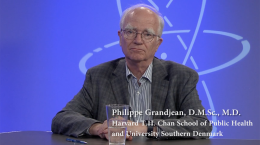
How Delayed Release of Industry Data on Chemical Toxicity Impacts Public Health
A prominent endocrinologist discusses the health and environmental impact of perfluorinated compounds (PFAS, PFOS), chemical compounds used in many products -from popcorn bags to fire-fighting foam to upholstery materials. These compounds are now found globally -- in people, animals, and environment. They affect, among other things, the brain, kidneys and the immune system, and are associated with a number of diseases. The producers of PFOAs were aware of the toxicity of these chemicals even in the late 1970s, but only recently have scientists been able to obtain that data. Because PFAS remain in the body over the lifespan, the withholding of data for decades has undermined medical research.Partner:Science for the Public