-

Civic Activism with David Hogg
David Hogg, a co-founder of March For Our Lives, joins Boston Public Library President David Leonard to discuss civic activism, gun control, and the impact of the movement Hogg helped to launch. On February 14, 2018, David Hogg’s life changed forever. As a senior at Marjory Stoneman Douglas High School in Parkland, Florida, David survived the largest school shooting in American history. Having lost friends, classmates and teachers, David decided to take action, so no other young person would have to experience what he went through on that fateful day. Since then, David’s activism has taken him around the country, meeting with impacted families and diverse communities to deepen his knowledge on gun safety and the politics surrounding the issue.Partner:Boston Public Library -

Frederick Douglass Prophet of Freedom
In this remarkable new biography of great American orator and abolitionist Frederick Douglass, historian David Blight has drawn on new information from both a private collection and recently discovered issues of Douglass newspapers. The first major biography of Douglass in a quarter century tells the fascinating story of Douglass's two marriages, his complex extended family, and his fierce support of the Republican party and black civil and political rights. An eloquent man and a thinker steeped in Biblical story and theology, Douglass became the most famed and widely traveled American orator of his time. [Old South Meeting House](https://osmhoct15-18.brownpapertickets.com/ "Old South Meeting House")Partner:Revolutionary Spaces -

How Fascism Works
By uncovering disturbing patterns that are as prevalent today as ever, philosopher Jacob Stanley reveals in _How Fascism Works: The Politics of Us and Them_ that the stuff of politics—charged by rhetoric and myth—can quickly become policy and reality. Only by recognizing fascists politics, he argues, may we resist its most harmful effects and return to democratic ideals. For this conversation Stanley is joined by Harvard associate professor of History Elizabeth Hinton.Partner:Harvard Book Store -

Daniel Ziblatt: How Democracies Die
Is American democracy at risk? Daniel Ziblatt, Harvard political scientist and coauthor of The New York Times bestseller, “How Democracies Die,” discusses how we can look to a wide range of historical and global examples, from 1930s Europe to contemporary Hungary, Turkey, and Venezuela, to the American South during Jim Crow to show how democracies die—and how ours can be saved. Professor Ziblatt’s talk is followed by a panel of Suffolk scholars –Brian Conley, Greg Fried, and Renee Landers – and is be moderated by Acting Provost Sebastian Royo. [http://www.lowellinstitute.org/](http://www.lowellinstitute.org/event/925/ "The Lowell Institute ")Partner:Ford Hall Forum -

How Many Languages Can You Learn?
How does the brain acquire and process language? How about multiple languages? And how about a whole lot of languages? Dr. Fedorenko describes what cognitive science knows and what is still to be learned. She and her associates focus on how the brains of multilingual people (polyglots) process very different types of languages. They also investigate those rare individuals who learn dozens of languages (hyperpolyglots).Partner:Science for the Public -

Gabriela Alemán: Poso Wells
Ecuadorian author Gabriela Alemán is joined by writer and translator Dick Cluster to discuss Alemán’s first work to appear in English: _Poso Wells_. Described as a feminist eco-thriller featuring corrupt politicians and greedy land speculators, _Poso Wells_ defies a genre, being part sci-fi, part satire and scathing in its treatment toward those in power in Ecuador.Partner:Brookline Booksmith -

Designing Climate Resilience
Presenters from the architecture profession use case studies to talk about best practices for site specific interventions that work well with neighborhood-wide plans. The panel focuses on district-wide approaches to climate adaptation that are relevant throughout the Greater Boston area where sea levels rise and flooding increases due to climate change that are forcing us to think, design and plan better. Image: [BSA](https://www.architects.org/programs-and-events/designing-climate-resilience-forum "BSA")Partner:Boston Society of Architects/AIA and the BSA Foundation -
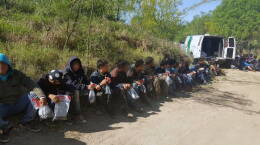
Jazmine Ulloa: Reporting on the Borderlands
Jazmine Ulloa has covered stories on immigration and life at the Mexican-American border as a reporter in Texas and California. She visited Harvard's Shorenstein Center to discuss issues brought into a brighter light under the Trump administration, namely the numerous challenges both legal and undocumented immigrants face in the United States. Photo: [U.S. Customs and Border Protection](https://www.flickr.com/photos/cbpphotos/ "")Partner:Shorenstein Center on Media, Politics and Public Policy -

Sarah Smarsh: Heartland
Sarah Smarsh was born a fifth generation Kansas wheat farmer on her paternal side and the product of generations of teen mothers on her maternal side. Through her experiences growing up as the daughter of a dissatisfied young mother and raised predominantly by her grandmother on a farm thirty miles west of Wichita, we are given a unique and essential look into the lives of poor and working-class Americans living in the heartland. Smarsh's personal history affirms the corrosive impact intergenerational poverty can have on individuals, families, and communities, and she explores this idea as lived experience, metaphor, and level of consciousness.Partner:Harvard Book Store -

Wide Lens Discussion: Alexandria Ocasio-Cortez on Fahrenheit 11/9
Michael Moore's latest film, [Fahrenheit 11/9](https://fahrenheit119.com/ "official movie website") (see trailer below), is described as a movie to " end the madness." It takes a critical look at how Americans came to elect Donald J. Trump in the Presidential elections of 2016. After the screening of the film in Brookline, Massachusetts, congressional candidate Alexandria Ocasio-Cortez joined Dr. Raul Fernandez on stage to respond to issues raised by the film (in which she appears) as well as talk about her own campaign for the 2018 mid-term elections.