-

The "First Amendment Award" Presented to Marty Baron
Watch Marty Baron, Executive Editor of _The Washington Post_ and former Editor of _The Boston Globe_, receive the Ford Hall Forum's First Amendment Award. The award recognizes Baron for his fearless defense of the free press. Baron’s relentless pursuit of the truth over his storied career and his defense of journalists especially in these turbulent times for the Fourth Estate has resulted in impactful and important journalism, with implications for years to come.Partner:Ford Hall Forum -

Mill Talk: Poetry Fuels Democracy - An Evening with Poet Richard Blanco
Cambridge Forum and Charles River Museum of Industry and Innovation co-present former poet laureate Richard Blanco who reads from and talks about his new book, _How To Love A Country._ As a presidential inaugural poet, educator, and advocate, Blanco has crisscrossed the nation inviting communities to connect to the heart of the human experience and our shared identity as a country. In this new collection of poems, his first in over seven years, Blanco continues to invite a conversation with all Americans.Partner:Cambridge Forum Charles River Museum of Industry & Innovation -
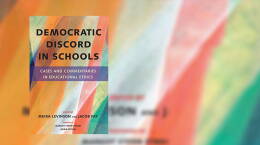
Democratic Discord in Schools: Cases and Commentaries in Educational Ethics
There is no easy answer to the question of how to teach children about democracy. How can teachers remain nonpartisan as they explain how the system works? "Democratic Discord in Schools" features eight cases of complex dilemmas drawn from real events designed to help educators practice the type of collaborative problem solving and civil discourse needed to meet these challenges of democratic education. Meira Levinson and Jacob Fray draw upon research methods developed in the[ Justice in Schools project](https://www.justiceinschools.org/) (https://www.justiceinschools.org/) at the Harvard Graduate School of Education (HGSE) to provide the tools needed by educators to practice the deliberative skills they need in order to find reasonable solutions to common ethical dilemmas in politically fraught times. Image: Book CoverPartner:Harvard Book Store -

The Genetic Revolution
Innovation Hub's Kara Miller and Marketplace Tech’s Molly Wood lead a fascinating conversation about the genetics revolution: how it's helping to create breakthrough medicines, why it’s raising privacy concerns, and how the cost of research is impacting drug prices. This event's panel of experts include Katrine Bosley, a biotech entrepreneur and former President and CEO of Editas Medicine, Safi Bahcall, co-founder and former President and CEO of Synta Pharmaceuticals, Joep Muijrers, Ph.D in Molecular Biology, Chief Financial Officer at the Venture Capital Firm PureTech Health and Barry Werth, author of The Antidote and The Billion-Dollar Molecule for an in-depth conversation. Image: [Pixaby](http://pixabay.com/illustrations/dna-genetic-material-helix-proteins-3539309/)Partner:WGBH -

Psychiatric Drugs: Why They Often Fail Us Over Long Term
More than one in five Americans now takes a psychiatric medication. Yet, as our use of these medications has soared, so too has the burden of mental disorders in our society. Why would this be so? Unfortunately, research has shown that long-term outcomes for medicated patients are poor. As a result, new initiatives are emerging that lessen the use of medications and focus instead on creating supports that help children and adults struggling with mental difficulties get well and stay well. Photo: [Cappi Thompson on Flickr](https://www.flickr.com/photos/34637679@N04/40258997254)Partner:Science for the Public -

Disruptive Media—Drone technology as empowerment
Drones are a disruptive, democratizing technology, allowing us to investigate space, architecture, and separation between communities in a radically empowering way. Johnny Miller’s project Unequal Scenes does just that; removing the personal and subjective gaze and forcing the viewer to confront systematic disenfranchisement from above. By putting this power into everyone’s hands, drone technology allows everyone to explore and examine their own neighborhood without needing intermediaries and gatekeepers. This is a fundamental shift in how we, as citizens, can understand the hidden networks, infrastructure, and systems in which our society is shaped, and which our lived experiences reflect. Miller is the photographer behind Unequal Scenes, and also africanDRONE, a NPO dedicated to empowering Africans to use drones for good. In this interactive discussion, Miller will explain why he believes drones, photography, and various forms of emerging media should be actively championed as enabling technologies of democracy, of positive, community-building practices, and explain how they can support educational initiatives to empower us all. Image: [Boston Society of Architects](https://www.architects.org/programs-and-events/disruptive-media—drone-technology-empowerment "Boston Society of Architects")Partner:Boston Society of Architects/AIA and the BSA Foundation -

The Greenidge Sisters present “FEM Tour”
The Feminist History Road Trip (FemTour) seeks to identify and explore sites and places connected to women’s history in the U.S. Women’s history sites are defined as places where events or people relevant to the history of gender in America occurred. The FemTour is particularly interested in sites connected to the history of women of color, working-class women, queer women and women who are often overlooked in Women’s Studies. The Greenidge Sisters are eager to explore sites across the United States, in as many regions as possible, and recognize that women’s history is not monolithic; that the experience of gender relies as much on a woman’s race and class as it does on a woman’s perceived sex. The sisters seek the uncomfortable stories, the stories that do not fit into a neat narrative, and the stories that bring up as many questions as they do answers.Partner:Boston Public Library -

BostonTalks: Forcasting Food
Look ahead to the future of food through the eyes of local chefs and experts at this BostonTalks about forecasting food. BostonTalks is WGBH’s smarter happy hour. It’s smarter because we feature three short talks, and it’s happy hour because the entire event takes place in a setting with drinks, conversation and occasionally some trivia.Partner:WGBH -

Bill McKibben: Falter
Bill McKibben discusses his book _Falter: Has the Human Game Begun to Play Itself Out?_ Thirty years after McKibben released his groundbreaking book _The End of Nature,_ the first book to alert us to global warming, he returns to evaluate the danger today: even as climate change shrinks the space where our civilization can exist, new technologies like artificial intelligence and robotics threaten to bleach away the variety of human experience. _Falter_ tells the story of these converging trends and of the ideological fervor that keeps us from bringing them under control. And then, drawing on his experience in building [350.org](http://https://350.org/) , the first truly global citizens movement to combat climate change, McKibben offers ways out of the trap. He warns us we're at a bleak moment in human history—and we must confront that bleakness or watch civilization falter. Image: book coverPartner:Harvard Book Store -

They Were Her Property
In _They Were Her Property_, Jones-Roger writes that women typically inherited more slaves than land, and that enslaved people were often their primary source of wealth. Not only did white women often refuse to cede ownership of their slaves to their husbands, they employed management techniques that were as effective and brutal as those used by slave-owning men. White women actively participated in the slave market, profited from it, and used it for economic and social empowerment. By examining the economically entangled lives of enslaved people and slave-owning women, Jones-Rogers presents a narrative that forces us to rethink the economics and social conventions of slaveholding America. Image: Book CoverPartner:Cambridge Forum