-

How Nanotechnology is Revolutionizing Medicine
Dr. Sameer Sonkusale’s Nano Lab at Tufts University is a major hub of nano-tech research in medicine and medical engineering. The nano-scale represents a unique space for physical processes and the Tufts Nano Lab has developed many distinctive innovations. Dr. Sonkusale discusses how such innovations provide detailed monitoring of medical problems and the development of precise delivery of medications to affected areas of the body. Image: Alonso Nichols, Tufts University, CC BY-NDPartner:Science for the Public -

A Conversation with Reporter Cristina Quinn
The Tavern Talks series with Arjun Singh, hosted at Atwood's Tavern in Cambridge, Mass., spotlights a wide array of guests, including journalists, authors, local politicians, artists, musicians and specialists of all sorts. In this talk, WGBH Reporter Cristina Quinn shares the backstory of her recent reporting on video game addiction and public health in Massachusetts. See Cristina's story, ["When A Gaming Hobby Becomes An Addiction, This Doctor May Have The Solution"](https://www.wgbh.org/news/local-news/2020/01/14/gaming-when-a-hobby-becomes-an-addiction-this-local-doctor-may-have-the-solution) (Jan. 14, 2020, WGBH News)Partner:Atwood's Tavern -

Bob Garfield: American Manifesto
Bob Garfield, cohost of WNYC’s weekly Peabody Award–winning On the Media, discusses his latest book, American Manifesto: Saving Democracy from Villains, Vandals, and Ourselves. He is joined in conversation by WGBH correspondent Arun Rath. As is often observed, Trump is a symptom of a virus that has been incubating for at least fifty years. But not often observed is where the virus is imbedded: in the psychic core of our identity.
In American Manifesto: Saving Democracy from Villains, Vandals, and Ourselves, Bob Garfield examines the tragic confluence of the American preoccupation with identity and the catastrophic disintegration of the mass media. Garfield investigates how we’ve gotten to this moment when our identity is threatened by both the left and the right, when e pluribus unum is no longer a source of national pride, and why, when looking through this lens of identity, the rise of Trumpism is no surprise.
Overlaying that crisis is the rise of the Facebook-Google duopoly and the filter-bubble archipelago where identity is tribal and immutable. Image: Book CoverPartner:Harvard Book Store -
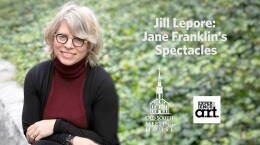
Jill Lepore: Jane Franklin’s Spectacles
Historian Jill Lepore tells the story of Benjamin Franklin’s long-forgotten sister, Jane, and meditates on what it means to write history not from what can be found, but from what has been lost. Presented by the [American Repertory Theater](https://americanrepertorytheater.org/) and [Revolutionary Spaces](https://www.revolutionaryspaces.org/) .Partner:Revolutionary Spaces -

Effects of Climate Change on New England Forests
In New England, rising temperatures will lead to a smaller winter snowpack and increased frequency of soil freeze/thaw cycles, which may damage trees and decrease the ability of our forests to sequester carbon and serve as habitat for some animals and microbes. Dr. Templer describes how her lab determines the effects of these changes in climate on the health of northern hardwood forests and the implications for water and air quality. Image: Pexels.comPartner:Science for the Public -

Andrew Bacevich: The Age Of Illusions
Andrew Bacevich, Professor Emeritus of International Relations and History at the Boston University, discusses his new book about the post-Cold war follies and delusions that culminated in the age of Donald Trump. The forum is moderated by journalist Christopher Lydon, host of Open Source radio. How, within a quarter of a century, did the United States end up with gaping inequality, permanent war, moral confusion, and an increasingly angry and alienated population, as well as the strangest president in American history? Image: Book CoverPartner:Cambridge Forum -

Food Waste: Can We Reach Zero?
Each year, American consumers, businesses, and farms spend $218 billion a year growing, processing, transporting, and disposing of food that is never eaten. That’s 52 million tons of food sent to landfill, plus another 10 million tons discarded or left unharvested. Food waste is responsible for roughly the same amount of greenhouse gas emissions as 37 million cars. At the same time, one in seven Americans is food insecure. The concept of “waste” is changing, and companies are embracing the circular economy where unused or discarded products can be reused to make new products. In the food industry, entrepreneurs are stepping up to seize opportunities. They are developing solutions bringing efficiencies to the supply chain (upstream) and reducing food waste (downstream). They are also using less water and energy, as well as looking for new solutions to soil improvement. In this discussion and presentation from seven local start-up companies, guest speakers will try to explain the systemic causes of food inefficiencies and define what it means to move toward "zero food waste." They will also showcase innovations and talk about new opportunities in manufacturing, farms, and upcycling. **Startup Exhibitors:** [AdaViv](https://www.adaviv.com/) [Cambridge Crops](https://www.cambridgecrops.com/) [GreenChoice](https://www.greenchoicenow.com/) [Magnomer](https://www.magnomer.com/) [New Bedford Port Authority](https://portofnewbedford.org/) [Shameless Pets](https://shamelesspets.com/) Photo from Han Cheung's video ["Tracing Dining Hall Food Waste"](http://Tracing Dining Hall Food Waste). CC 2012Partner:MIT Enterprise Forum Cambridge -

WGBH News Forums: How To Spot Fake News
WGBH News and the Forum Network begin 2020 with an original, news-focused speaker series that will provide a closer look at the presidential election season. In these quarterly events, audience members can connect to WGBH News reporters and experts who will help navigate a heavy year of political coverage. This first event focuses on how to spot “fake news” in an age of disinformation, with a panel of scholars who study media manipulation, digital resources, and the spread of misinformation. The discussion is moderated by WGBH News Senior Digital Managing Editor, Laura Colarusso. Photo: Ryan Arel/Forum NetworkPartner:GBH Forum Network -

The Curious Person's Guide to Earth Repair: Regenerating Soil and Water Landscapes
Over the past year, the public has grown increasingly aware of the ways we have inadvertently harmed the biodiversity and ecosystems upon which life depends. The United Nations having declared [2021-2030 the Decade of Ecosystem Restoration](https://www.unenvironment.org/news-and-stories/story/new-un-decade-ecosystem-restoration-inspire-bold-un-environment-assembly) presents the opportunity for a global focus on regenerating natural systems. Journalist and author Judith D. Schwartz has travelled widely to find people who are successfully restoring healthy soil and water ecosystems. She talks with Cambridge, MA activist Nicola Williams about her research as well as a forthcoming book about the global ecosystem restoration movement. Photo: ["Red pouch fungus" Tony Wills](https://commons.wikimedia.org/wiki/File:Red_pouch_fungus_01.jpg) [[CC BY 2.5](https://creativecommons.org/licenses/by/2.5) ]Partner:Biodiversity for a Livable Climate -

The Impact of Air Pollution on Health
Dr, Levy discusses the increasing and serious health issues associated with air pollution, particularly in urban areas. Health and environmental scientists are particularly concerned about the effects of particulate matter (PM2.5), which enters the bloodstream via the lungs, on human health. The result is seen in rising rates of heart disease, asthma, and cognitive problems. Image: [Science For The Public ](http://scienceforthepublic.org/medical-research/the-impact-of-air-pollution-on-health)Partner:Science for the Public