-

The Vote: A Conversation on Women’s Suffrage
Secretary Hillary Rodham Clinton joins writer, producer and director Michelle Ferrari and other guests for an important and timely conversation inspired by the new American Experience film, "The Vote." Commemorating the 100th anniversary of the passage of the 19th Amendment, "The Vote" tells the dramatic story of the hard-fought campaign waged by American women for the right to vote. This transformative cultural and political movement resulted in the largest expansion of voting rights in U.S. history. For this special conversation, WGBH and American Experience convened panel of extraordinary women to discuss the history of the women’s suffrage movement, what it reveals about the mechanics of American democracy, how it connects to other campaigns for equality, and the insight it offers to the challenges facing women and the nation today. Secreatary Clinton and Michelle Ferrari are joined by Martha S. Jones, historian and author of "Vanguard: How Black Women Broke Barriers, Won the Vote, and Insisted Upon Equality for All" and Elaine Weiss, author of "The Woman’s Hour: The Great Fight to Win the Vote". The panel addresses a selection of questions submitted by virtual webinar audience members. Watch the full film of The Vote on PBS.org and the PBS Video App. For more information visit: https://www.pbs.org/wgbh/americanexperience/films/vote/.Partner:WGBH -

Misinformation Wars
How does information, as well as misinformation impact public understanding of the COVID-19 pandemic? Distribution of information in this global crisis is a powerful role: where, how and from whom do people get their information and how does it shape their behavior? A panel of experts look closely at research happening in real time during the pandemic on the rapid decline in trust in public institutions, public figures, and the media. They discuss the resulting impact on the health of democracy. The panel includes Felice J. Freyer, a health policy and public health reporter at The Boston Globe; Jennifer Kavanagh, a senior political scientist at the RAND Corporation; Jonas Kaiser, an affiliate at Harvard’s Berkman Klein Center for Internet & Society; and Shoshana Madmoni-Gerber, an associate professor of Communication, Journalism, & Media and Suffolk University. **Follow the Course: Week #2 Assignment** Listen: FiveThirtyEight: [One Virus, A World Full Of Responses from FiveThirtyEight Politics](https://podcasts.apple.com/us/podcast/fivethirtyeight-politics/id1077418457?i=1000475357937) Read: NGA [Coronavirus What You Need To Know](https://www.nga.org/coronavirus/#actions) (compare different actions taken by U.S. States in response to Covid-19) Washington Post: [How Democracies Can Survive Dilemmas like coronavirus](https://www.washingtonpost.com/politics/2020/05/13/how-democracies-can-survive-crises-like-coronavirus/) Washington Post: [Which Kind of Democracies Respond More Effectively to a Pandemic?](https://www.washingtonpost.com/politics/2020/05/19/which-kinds-democracies-respond-more-effectively-pandemic/) Mischiefs of Faction: [To Crack Down on Dissent in Hong Kong, Beijing is Sidelining Local Democratic Institutions ](https://www.mischiefsoffaction.com/post/to-crack-down-on-dissent-in-hong-kong-beijing-is-sidelining-local-democratic-institutions?postId=5ec828796fa6b600176fd79c) Freedom House Reports:[Democracy During Pandemic](https://freedomhouse.org/issues/democracy-during-pandemic) and [Digital Election Interference](https://freedomhouse.org/report/freedom-on-the-net/2019/the-crisis-of-social-media/digital-election-interference) **Civic Engagement Activity & Reflection** Engage in at least one civic / political event of your choice during the course and document this with a short reflection essay. Try a virtual town or city hall meeting with local or state representatives, a meeting of an activist group, etc. The reflection should draw on readings from assignments and your own additional research. Members of the public who wish to share their reflections should post a link on Twitter and tag [@GBHForumNetwork ](https://twitter.com/GBHForumNetwork) and [@supolscilegal](https://twitter.com/supolscilegal).Partner:Ford Hall Forum -

A Meditation on Indigenous Life
Poetry and visual art by Mashpee Wampanoag poet, artist, and author Robert Peters comes to life in an original, multi-media performance. This premiere performance features Peters’ poetry/art collection “Thirteen Moons,” which evolved through the artist’s personal journey to reclaim traditional culture and to live in a way consistent with his traditional beliefs. A choral reading of the “Thirteen Moons” poetry collection sets the stage for a conversation with Peters and other Indigenous artists. Topics considered include humans’ relationship with the natural world, the meaning of “home” from a Native perspective, and the contributions of Indigenous voices to justice and democracy building today. Image: Artist ImagePartner:Revolutionary Spaces -
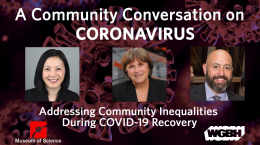
Addressing Community Inequalities During COVID-19 Recovery
As the United States begins to recover from the disruption created by the COVID-19 pandemic, it's time to focus on the long-term impacts of changing social practices and economic harm. The harsh reality of COVID is that it has disproportionately impacted underserved communities. In Massachusetts, without a concerted effort on the part of policy and healthcare workers, those impacts may continue to grow over the coming months and years. In particular, experts say food insecurity and healthcare access must become focal points of successful, long-term recovery plans. As part of the [**Hunger to Health Collaboratory**](https://www.hungertohealthcollaboratory.org/), the Museum of Science has convened a panel of experts to discuss COVID in our communities. Dr. Kara Miller, host of the radio show [**Innovation Hub**](http://blogs.wgbh.org/innovation-hub/2011/1/1/about-innovation-hub/) from WGBH and PRX, moderates a discussion with Catherine D’Amato, President and CEO of the Greater Boston Food Bank, Dr. Holly Oh, Chief Medical Director at the Dimock Health Center, and Marty Martinez, Chief of the Mayor’s Office of Health and Human Services for the city of Boston. They discuss concerns surrounding food insecurity, healthcare access, and other issues that will arise in our most vulnerable neighborhoods while living in COVID times. Also, the Museum of Science is offering free virtual programming daily from live presentations, virtual exhibits, STEM activities, and more. Please visit https://mos.org/mos-at-home for our virtual offerings.Partner:Museum of Science, Boston -

Biking While Black: Tackling Racism in Cycling and TOD
The recent protests around the world restating that “Black Lives Matter” has ignited candid conversations about racism everywhere. People around the world are starting to understand how widespread systemic racism and micro-aggressions have been for people of color, especially Black people. Patterns of exclusion and marginalization have been no different in transportation, including cycling. Los Angeles-based Social Justice Advocate and Consultant Tamika L. Butler, Esq., MassINC’s Dr. Tracy Corley, WGBH Reporter Bob Seay, and Alex Weck of R.A.D in Springfield, MA discuss how cycling, transit, and other systems and infrastructure in our cities and neighborhoods perpetuate the excessive monitoring and policing of Black and Brown bodies in public spaces. They discuss these challenges, what more we need to do to bring anti-racist policies and practices to cities across the Commonwealth, and how equitable transit-oriented development can help transform our relationships with each other in public places. Image: Pexels.comPartner:MassINC -

Physics Beyond the Standard Model at The Large Hadron Collider
Professor Klute provides an update on the work at the Large Hadron Collider. He discusses that the Standard Model is incomplete. The projects at the Large Hadron Collider search for the missing information. Markus Klute’s group played a central role in the discovery of the Higgs boson in 2012, and continues the search for subatomic particles that can reveal the origin of the universe and the nature of matter. In this update on the LHC Dr. Klute explains how the LHC experiments probe for unknown particles, and he discusses the recent announcement of the future plans of the LHC. Image: Belmont Media CenterPartner:Science for the Public -
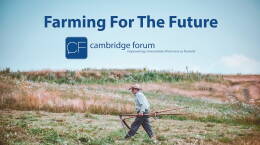
Farming For The Future
This forum features three uniquely different farmers who are all equally passionate about smart and sustainable ways of growing our food. Addy Shreffler is a young but savvy farmer, who was an executive chef for several years before migrating into farming. Michael Chuisano is the owner of the Naked Farm in Marion, New York. Ronnie Cummings is an organic farming guru and member of the Regeneration International movement.Partner:Cambridge Forum -

Architect Marsha Fader: Preserving Nantucket's Hidden Jewel
Learn about 200 years of Black land ownership on Nantucket Island with award-winning architect Marsha Fader and moderator Sylvia Stevens-Eduoard. Fader won the 2020 Architectural Preservation Award from the Nantucket Preservation Trust for the multi-year restoration of the Boston-Higginbotham House belonging to the Museum of African American History. The house was constructed c. 1774 by Seneca Boston, a weaver and formerly enslaved man. The home is especially important as it boasts more than 200 years of ownership by free Black Nantucketers. Image: Speaker PresentationPartner:Museum of African American History -

A Patchwork of Responses to the Pandemic in Comparison
The COVID-19 pandemic is a global event unlike any other experienced in the contemporary era. Its size, scope, reach, and implications are enormous, ongoing, and unequal. Outcomes — from how people all over the world will live their daily lives to whether democracy will survive — are all in question. This free, 9-week-long lecture series is designed to be a broad survey of many of the themes most of interest to political scientists and public policy experts and is part of an online course Suffolk University is offering this summer to incoming students. Panelists will discuss the differential impact of the pandemic around the world, and the differential responses across nations, comparing countries, regions and states in the context of democracy, populism, public trust, and compliance. To kick things off, Sebastián Royo, Ph.D., an expert on Southern European politics at Suffolk University, sits down with Mahrukh Doctor, Ph.D., an expert on Latin America focusing on Brazil at the University of Hull, and Vivien Schmidt, Ph.D., an expert on European political economy and institutional legitimacy at Boston University. _Image credit: Gina Jano Design_ **WEEK 1 ASSIGNMENTS** Listening assignment: Council on Foreign Relations "Epidemics in World History" https://www.cfr.org/podcasts/epidemics-world-history-frank-m-snowden Readings Weather Conditions & Covid-19 Transmission https://projects.iq.harvard.edu/covid19 “What History Can Teach Us About Building a Fairer Society after Coronavirus” by Richard Sayeed https://www.theguardian.com/commentisfree/2020/apr/18/history-fairer-society-coronavirus-workers-black-death-spanish-flu Civic Engagement Activity & Reflection Students will be required to engage in at least one civic / political engagement event of their choice during the course of the term and document this with a short reflection essay. The type of event you attend remotely is up to you. It can be a virtual town or city hall meeting with local or state representatives, a meeting of an activist group, etc. The reflection must draw on readings from the class and your own additional research. Members of the public who wish to share their reflections should post a link on Twitter and tag [@ForumNetwork](https://twitter.com/ForumNetwork) and [@supolscilegal](https://twitter.com/supolscilegal).Partner:Ford Hall Forum -

America’s Real Economic Experience
Author Tara Westover, economist Gene Sperling and Setti Warren, Executive Director of the Shorenstein Center, discuss what’s really happening economically to people in communities across America. Many media organizations and elite institutions continue to promote GDP, stock market and unemployment metrics as leading indicators on the health of the economy. Yet, we know these measures do not reflect the economic reality for millions of people across America. The COVID-19 pandemic and recent protests against structural racism have highlighted the gap between how the economy is portrayed in the media and by elite institutions, and the reality that people live every day. This talk examines this gap between perception and reality, how it is playing out across the country, and the impacts it has.Partner:Shorenstein Center on Media, Politics and Public Policy