-

Racial Justice in America: Reflections on the Past, Present and Future
In 2020, people across the United States took to the streets to protest racism and police brutality. In this Hot Buttons, Cool Conversations event, we examine how structural racism has fueled inequity and reflect on our nation’s long legacy of racial injustice. We explore how America's current engagement in fighting racial oppression differs from movements in the past, and look ahead to the future, and the hope for meaningful change. Associated Press investigative reporter Kat Stafford moderates a conversation with Dr. Keisha N. Blain, Associate Professor of History at the University of Pittsburgh and the president of the African American Intellectual History Society and Dr. Khalil Gibran Muhammad, professor of History, Race and Public Policy at Harvard Kennedy School and the Suzanne Young Murray Professor at the Radcliffe Institute for Advanced Studies. This event is part of the JCC Greater Boston's Hot Buttons, Cool Conversations acclaimed discussion series bringing together distinguished scholars, thought leaders and expert moderators for thought-provoking dialogue on issues of concern to the Jewish community and beyond. Produced in partnership with GBH Forum Network. Image: Life Matters, PexelsPartner:JCC Greater Boston -

How will our public transportation system recover after the pandemic?
The pandemic has led to dramatic decreases in ridership on mass transit. In response the MBTA is cutting and reducing service on bus and subway routes, commuter rail and ferries. Officials say when the pandemic eases and demand comes back, service will return. But will it? And if it does, will it look like it did before? What does this mean for cities and towns across the state and how should we adapt? With a focus on equity and impact, MassINC and the GBH Forum Network explore these issues with Jarred Johnson of TransitMatters, Veronica Vanterpool of Delaware Transit Corporation and Mayor Thomas McGee of Lynn, MA. _This event is part of the TTOD "Transformative Transit-Oriented Development" Talks sponsored by MassINC and is produced in collaboration with GBH Forum Network._Partner:MassINC -
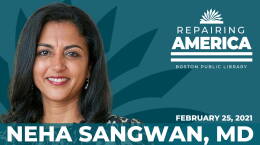
How to Use the Disruptive Energy of a Pandemic to Thrive
Dr. Neha Sangwan, physician, communication expert, and author sits down with BPL President David Leonard to talk about how to adapt work in the pandemic and leverage stress energy to make positive change. As the institutions, norms and rules that once held the fabric of our society together dissolve, the businesses that will thrive now are the ones that adjust most quickly to our new reality. One of the biggest predictors of success will be the quality of leadership in your organization. Dr. Sangwan addresses building trust within and across teams, learning to navigate and override strong emotions within the team, and how to help them pivot and innovate to meet the needs of our ever-changing world. Think of it as upgrading your human software to not only meet the challenges of a complex world, but also excel under pressure! The Kirstein Business Library & Innovation Center (KBLIC) invites media creators, innovators, job seekers, entrepreneurs, nonprofits, investors, coders, and makers to our new space. Business-minded individuals can enjoy an inviting and modern space with over 5,000 square feet of printed resources, flexible seating, innovative technology to conduct business research, and dedicated areas for collaborating on projects with colleagues or developing a new career skill. [**The Repairing America Initiative**](https://forum-network.org/series/boston-public-library-repairing-america/) is the Boston Public Library's pledge to focus its 2021 programming and services on bridging the gaps that divide America. By prioritizing economic recovery, civic engagement, COVID-19 recovery, racial equity, workforce development, and youth engagement, the BPL is working to help Americans rise above the challenges they face.Partner:Boston Public Library -

Fixing What’s Broken: Climate & Environmental Policy
President Biden has promised an all hands on deck approach to tackling climate change, which he has described as an existential threat. To start, he created two new positions in the National Security Agency with an exclusive focus on climate at home and abroad. He has asked the National Intelligence, Defense and Treasury agency directors to add ecology to their portfolios. Finally, Biden took swift action during his first weeks in office to rejoin the Paris Climate Accord, revoke the permit for construction of the Keystone XL pipeline and order a review of hundreds of executive orders thought to be harmful to the environment. Will these steps make progress toward slowing down climate change? Will a deeply divided Congress be able to act decisively to take the necessary steps, along with the rest of the world, to slow, stop or reverse our course? The Washington Post audio producer Arjun Singh moderates a discussion on the promises and obstacles to achieving Biden’s Climate Agenda with Rachel Cleetus, Union of Concerned Scientists; Michél Legendre, Corporate Accountability; and Sririam Madhusoodanan, US Climate Campaign. _Presented by the Suffolk University Department of Political Science & Legal Studies, in collaboration with the Ford Hall Forum at Suffolk University and hosted by GBH’s Forum Network._ ### Resources Read Rachel Cleetus’s, [“A Biden Presidency Means a New Day in the Fight for Climate Action.”](https://blog.ucsusa.org/rachel-cleetus/biden-climate-priorities) Learn what Rachel Cleetus thinks is next after rejoining the Paris Agreement, [here](https://blog.ucsusa.org/rachel-cleetus/paris-agreement-us-whats-next). See research on the compound climate risks of the pandemic, [here](https://www.nature.com/articles/s41558-020-0804-2). Read the Union of Concerned Scientists’s, [“Underwater: Rising Seas, Chronic Floods, and the Implications for US Coastal Real Estate.”](https://www.ucsusa.org/resources/underwater)Partner:Ford Hall Forum -

Ethics: How to make good choices in a complicated world
Today’s ethical challenges are increasingly gray, often without a clear right or wrong solution, causing us to teeter on the edge of effective decision-making. With concentrated power structures, rapid advances in technology, and insufficient regulation to protect citizens and consumers, ethics are harder to understand than ever. How do we find a way forward? In _The Power of Ethics_, strategist Susan Liautaud shows how ethics can be used to create a sea change of positive decisions that can ripple outward to our families, communities, workplaces, and the wider world—offering unprecedented opportunity for good.Partner:Cambridge Forum -

Probing the Causes of Cancer
Dr. Denis is a leading researcher in the study of breast cancer, with a particular focus on the disproportionate occurrence of breast cancer in economically and socially stressed minorities. He studies the combination of socioeconomic factors and certain (BET) proteins in both breast and prostate cancers in his research. This mix of social and biological drivers is of increasing interest in medical research. Dr. Denis explains how this broader research is designed and tested –and how it will affect the fight against cancer today. Image: Belmont Media CenterPartner:Science for the Public -

An Amazing Agroforestry Story: The Inga Model in Central America
The Inga Foundation's founder and director Mike Hands has been working to halt the destruction of rainforests from slash and burn agriculture for over 20 years. An experienced tropical ecologist and scientific researcher, Mike divides his time between his farm in Cornwall, UK, and the Inga Foundation’s [Land for Life](http://www.ingafoundation.org/land-for-life/) program in Honduras. Now in year 10, the locally-led program has exceeded all expectations (100% organic food security, protecting wildlife and marine habitats, enriching and improving soil, and preserving water sources) and been recognized as a game changer for people and the planet with 2,600 acres of highly degraded land regenerated, and 284,000 tons of CO2 sequestered/avoided. The program is replicable to the entire humid tropics with native Inga. The "Guama Model" of Inga Alley Cropping with the nitrogen-fixing Inga has transformed the lives of 300+ rural, subsistence farming families who have planted over 4 million trees. The resilient, fast-growing Inga tree alleys provide annual, renewable firewood and survived 7 months of drought and the recent back-to-back hurricanes. Distinguished professor Rattan Lal talks with Mike Hands about the program's success and promise.Partner:Biodiversity for a Livable Climate -

The Color of Public Money — A Public Discussion
The next GBH News Forum. This time, we’re looking at inequities in government contracting and public spending revealed by the work of the GBH News Center for Investigative Reporting in its ongoing series, “The Color of Public Money.” The project first revealed in January 2020 that minority-owned businesses – and Black-owned businesses, in particular – get a tiny fraction of the billions of dollars spent by Massachusetts state agencies on contracts for a vast array of goods and services. In fact, minority-owned firms saw their share of state dollars decline over the past two decades. As the reporting continued, minority business groups pressed Governor Charlie Baker to respond. By the end of 2020 he relented, announcing that he would elevate the state’s minority contracting office to an independent state agency. More reforms – and reporting – are in progress. GBH News Forums: You’ve Got Questions, We’ve Got Experts.Partner:GBH Forum Network -

China’s Role in Africa
The Covid-19 crisis has put a massive strain on what was growing a positive economic and political relationship between China and the continent of Africa. As Chinese President Xi Jinping’s centerpiece “Belt and Road initiative” continues to expand Chinese power, the response to the spread of Covid-19, as well as the African government’s growing debt to China, has seen pushback. What are some of the growing economic and political issues between China and Africa? Hear a discussion on these themes with Dr. Lina Benabdallah, an assistant professor of Politics and International Relations at Wake Forest University. Image: WorldBostonPartner:WorldBoston -

Creating and Testing Vaccines
Dr. Douam explains how scientists unravel the mechanisms by which viruses such as covid-19 (SARS-CV2) invade cells and overcome the body’s defenses. We learn about the development of effective vaccines and the difference between mRNA and DNA vaccines. And we learn about the value of using humanized mice –mice engrafted with human tissues– which advance both the understanding of human immune responses and the improvement of vaccines. Image: Belmont Media CenterPartner:Science for the Public